

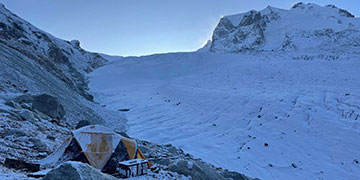
ETH researcher Thomas Hudson camped overnight beside the Gorner Glacier in the Alps, with the Monte Rosa massif and its main summit, the Dufourspitze (4634 m), visible in the background. [Image: Thomas Hudson, ETH Zurich]
Mountaineers, climate scientists and polar explorers all worry about hidden crevasses that can destabilize glaciers and ice shelves. Researchers in Switzerland, a country with plenty of snow and ice, have verified that a type of optical-fiber sensor can reveal the extent of subsurface cracks in glaciers (Sci. Adv., doi:10.1126/sciadv.aef1107).
With distributed acoustic sensing (DAS), a laser-powered optical-fiber strain sensor can replace hundreds of separate seismographs in a given area. The Swiss team used a single fiber cable to visualize glacial crevasses down to a depth of 25 m and to find water- and air-filled gaps constituting more than 8% of the ice volume in the region studied.
DAS for glaciers
Scientists have known that fracturing ice under the surface of glaciers generates seismic waves, just as breaking and shifting rock faults lead to earthquakes. But deploying traditional seismographs across a suspected field of crevasses is costly—and potentially dangerous for researchers deploying the instruments.
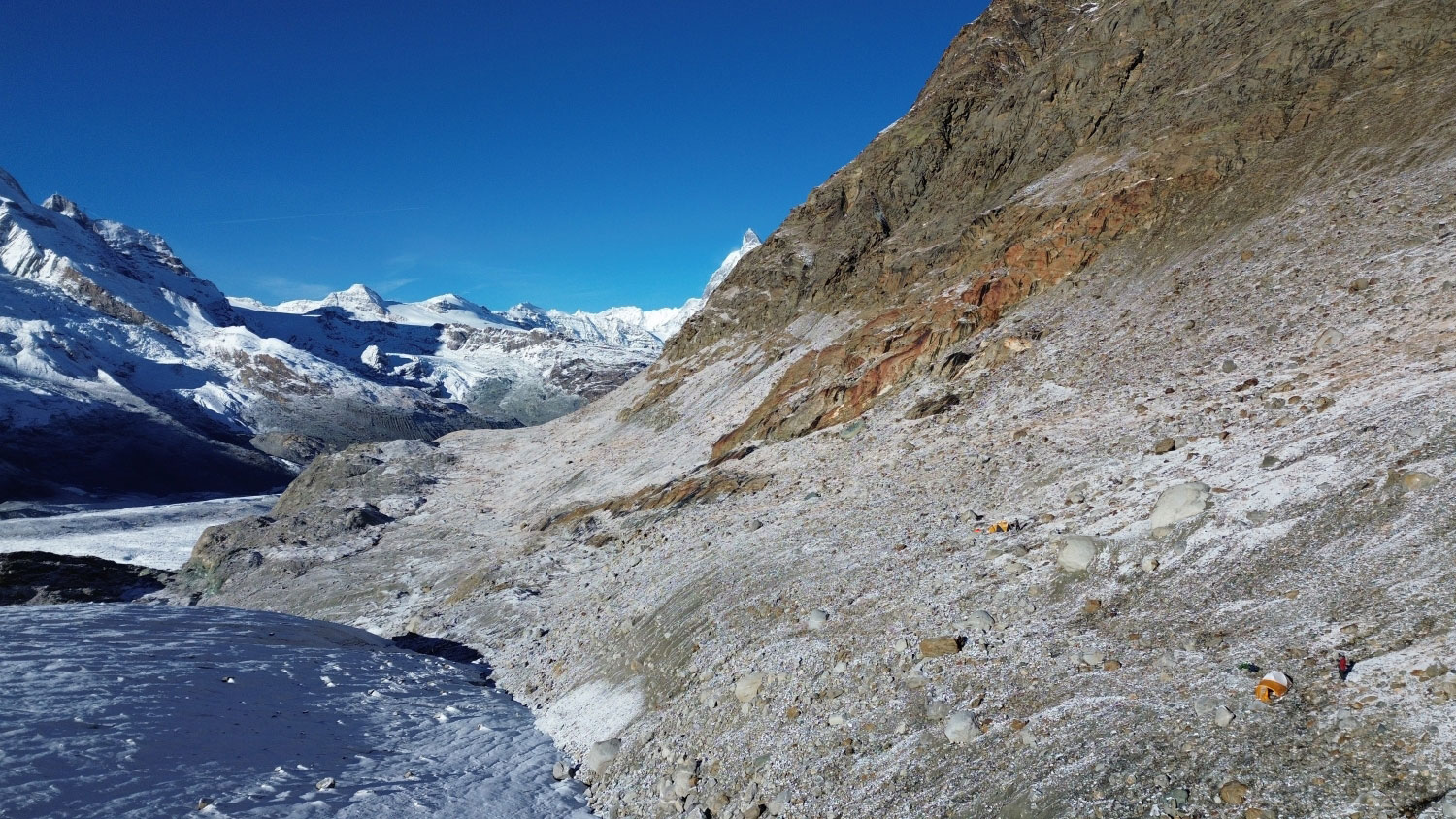
Alpine mountain scenery at the Gorner Glacier in Switzerland. The tent housing the fiber optic seismological measuring device can be seen at the bottom right of the image. [Image: Thomas Hudson, ETH Zurich]
Instead of these multiple devices, DAS employs a single optical fiber guiding a train of laser pulses. Differences in the strain along the fiber create phase changes in the backscattered light. The light comes from the interrogator attached at the end of the fiber, which sends out the pulses and records the tiny reflections.
As a test case, the team from ETH Zurich focused on the Gorner Glacier, the second-largest glacier in the Alps. The researchers connected a commercially available DAS platform to a 1-km optical-fiber cable, slightly embedded into the surface ice during day‒night melting and freezing. Group leader Thomas Hudson laid out the fiber cable in a 2D grid with 29 micro-electrical-mechanical-system (MEMS) sensor nodes to detect vertical acceleration. The DAS channels monitored horizontal acceleration from the slight deformations that subsurface movements induced along the fiber.
Detecting “icequakes”
Over the course of a week, the DAS grid detected 1,355 “icequakes,” which happened more frequently when surface temperatures were above freezing. Computational analysis helped the researchers determine just how the glacier was fracturing below its surface.
Hudson’s team will use the technique on other Swiss glaciers as well as polar ice sheets, whose potential calving and melting could impact the world's oceans. “Our method could therefore help to predict changes in the ice sheets and sea levels,” Hudson said in a statement.
The work is also of immediate practical interest: As the ETH team was writing up its findings in May 2025, a glacial collapse elsewhere in the Swiss Alps destroyed the village of Blatten.
